New Albany is a state of mind … but whose? Since 2004, we’ve been observing the contemporary scene in this slowly awakening old river town. If it’s true that a pre-digital stopped clock is right twice a day, when will New Albany learn to tell time?
The long-awaited day has arrived, and the anchor-festooned junta will be awash in Bud Light Peach-A-Rita. Your "Deez Trump Nutz" calendar for 2020 is headed for the landfill, it's January 1, and NA Confidential has officially concluded its 16-year run.
Help me kill another decade, and maybe there'll be a box set.
Until then, or whenever Google/Blogger gets around to further atrocities against taste and decency, I'm proverbially OUTTA HERE. It will come as no surprise to anyone who knows me that I'm a bit behind schedule getting the new web site in the water, but no worries. The past few months have been busier than expected, but the site will begin soon.
If you're just tuning in, three recent essays explain why this has happened.
It cannot be denied that I’m a slow learner, a late bloomer and a serial procrastinator.
This much is perfectly clear. Actually, I’ve never cared enough to even try dodging these compliments.
The odd part has always been that once I get around at long last to learning, blooming and/or making up my mind, it’s a done deal. Once a decision has been determined, right or wrong, it is pretty much irrevocable with me.
So it was last week when I awakened to thoughts about NA Confidential’s future, and concluded it has none, at least in its present format. I'll continue writing elsewhere, and soon the blog will cease to exist as an active, ongoing entity.
NAC began in 2004 as a way of channeling a long-gestating insight, this being the importance of grassroots localism. It was and remains my view that people tend to obsess about hugely complex national and international topics to the exclusion of approachable issues outside their front doors, and in their own communities, because theatrically pontificating in broad terms is easier than getting involved with the grit and grime of specifics.
NAC started out as a diary of sorts, a place to chronicle my journeys, promote the beer businesses I was involved with at the time, channel my inner Mencken, and write about anything I damn well pleased. Other folks helped out with writing (Randy, Jeff, Lloyd), and then they didn’t.
The blog grew into a public gathering spot, a function that ebbed drastically once social media exploded. All along, it was a spot to broach subjects no one else would. I followed these stories where they took me, and it didn't always make people happy.
They're entitled to their own opinions, although not their own facts.
NA Confidential’s first post was on October 22, 2004. Who even imagined we’d still be talking about it in 2020? I didn't.
You don’t need a gumshoe with rotten breath and one too many alimony payments to figure out the problem with this town. It’s something in the water that causes people here to lose their vision. Q: What do New Albanians call Southside's mashed potatoes? A: Freedom Foie Gras. Well, we’re here to change all that.
Ha!
Change all that?
A tad cheeky, and ultimately a point to debate, although others can decide the extent, if any, of the blog’s influence hereabouts. Irrespective, the blogging experience has changed me, and nowadays I’m at a crossroads amid the crossfire. Consequently, there are several good reasons for acknowledging various irrefutable realities and drowning the blog in the nearest available bathtub.
Allow me to explore the reasoning.
---
Localism? Not so much. Between our toxic social media fixation, the pandemic and Trump’s invasive cult of personality, interest in provocative takes on local matters in Nawbany has largely disappeared. Readership has responded accordingly, by plummeting. This should please my betters.
Part of this decline owes to the scattershot essence of Blogger; it is an utter piece of crap, and a dysfunctional platform overall. For at least a decade Blogger has been unsuitable for my intentions. Now it’s largely unusable owing to recent revisions, and I should have exited long ago when the going was good. That one's on me.
In addition, I turned 60 in August, and began paying attention to what the mirror (and my wife) was trying to tell me about the meaning of life. In short, it’s time for an autumn (of my years) deep cleaning and reboot. What better time than multiple, horrifying daily existential crises?
Then an e-mail notice came, reminding me it was time to renew my rogerbaylor.com domain name. Having finally learned a bit about WordPress owing to my position as digital editor at Food & Dining Magazine, and with the publication’s house web guru Jason around to advise me, starting anew at my own web site suddenly became an attractive option.
The year 2020 already was the most tumultuous year of my life, and probably yours, too. Why not end it with closure, by euthanizing NAC, and moving forward to something different?
---
Of course there’s another aspect to the blog’s impending termination, a process which began in earnest the moment last year’s municipal election cycle concluded.
Jeff Gahan’s unprecedented third mayoral term (save for C. Pralle Erni’s four), and especially his increased margin of victory in the 2019 election, constituted voluminous (and perhaps inevitable) handwriting on the wall. It was a clear, unmistakable vote for civic fantasy, and against truth telling, whether by a malcontent like me or on the part of perpetually somnolent local newspapers … or anyone else, for that matter.
It was, in fact, a slam dunk.
Accordingly, a solitary dissident at a blog parked at the woefully deficient Blogger hell hole simply cannot hope to make a difference in such a dismal, uncomprehending milieu. Ironically, what it can do is make the dissident’s own position unsustainable -- and it has.
None of this thrills me, but the truth of it is simply undeniable, and that’s why I’ll go through the narrative a final time before NAC self-destructs. Accordingly, let’s award credit where it’s due, sans snarkiness.
I fought Nawbany, and Nawbany won.
That's it, in a nutshell. As an intelligent, well-educated and worldly person, I can fully appreciate the tactical deficit of my coordinates in this pandemic year, as pinned down in a fox hole with massed (metaphorical) artillery pointed in my general direction.
Well played, dominant cadres. I've learned that "it's the way things work here" is more than a recurring promise; it's a big-ass buzz saw, and I'm sliced, diced and vanquished.
Evidently “check mate” means the same thing in all of those European languages I wish had come easier to me so as to facilitate being a joyful expatriate. It looks like we’re marooned here until the house is paid off. After that, Ireland (or Malta, or Bolivia; whatever), here we come.
Verily, the governing Nawbanian clique's “lone dissident on the grassy know-it-all” containment strategy for the past seven years has proven to be highly effective. Granted, it took a few dozen of them to whip one blogger acting alone, but make no mistake: The lash of the nabob's whip is real, and accordingly, I’m whupped.
Cutting me off from any “official” political and governing dialogue is only a small part of it, because the community pillars have completely succeeded in institutionalizing a local perception of me as social misfit and pariah, to be shunned by “right thinking” people as if I were a member of India’s untouchable caste.
Evidently if you whisper often enough that Roger’s a dangerous nutcase, otherwise sane and intelligent people will start to believe it. The ones who don’t? They'll merely say they regret the inconvenience, but just can’t risk being seen with you – you understand, they’ll say amid the furtive glances, it’s just business.
Yes, I understand the obligations of current accounts, although frankly, some of you should be ashamed to spend hours denouncing the perfidy of national Republicans while simultaneously encouraging crickets to chirp when it comes to the eually repellant habits of local Democrats. That’s cowardice, and it’s also hypocrisy. I genuinely feel bad for you, but really?
Toss a starving dog a bone. Maybe just a wee shred of resolve, every now and then?
What’s more, in so many of these "tsk tsk" instances, it has not mattered in the slightest what I actually said or wrote to prompt a flurry of finger-wagging; folks have concluded automatically that I’m mistaken, not to mention disreputable, based on what they imagined me saying or writing, and not actually hearing or reading it. Purportedly it is understood by those who – you know – understand these sort of things.
Frustrating, but also quite brilliant.
I’m stymied, hung out and left to dry. Like I said, full credit where it’s due. The Kool-Aid is strong, and I am weak. Long live the junta!
---
Furthermore, the ruling elite came to an astute recognition that while they cannot hurt me personally, people around me are vulnerable. It’s a crude, blunt-edged form of reprisal, as well as a highly efficient one. In good conscience I can no longer risk the threat of collateral damage to innocent bystanders.
Additionally, because the leading element in New Albany has successfully characterized NA Confidential in its diverse entirety as the equivalent of deranged snuff porn fetishism, the blog’s “brand” is compromised, stuffed into a straw man's cubbyhole and tainted by association.
Masterful, indeed.
My earnest efforts in 2020 to remove the political element from the blog have been easier than I imagined, but ultimately it's futile. The torture is unlikely to stop, the Blogger platform remains inadequate for future writing, and the blog as currently constituted is dead in the water, adroitly blockaded by local arbiters, blithely shunned by the aspirant vanguard, and abjectly short-circuited by its own host platform.
I can take a hint and surrender, dear (leader).
---
Granted, I might start again at a new website and continue calling it NA Confidential. But it needs to be retired. At the forthcoming Roger Baylor Dot Com there will be an archive of the 15,000+ posts appearing at NAC since 2004, albeit completely inactive in terms of new content. It will be maintained strictly for historical interest, and as a sketchbook for future writing.
Resurrecting NAC wouldn’t be the same. I played the game and lost. So it goes. It may not have been fair or square, and yet make no mistake; I knew exactly the nature of the surreal absurdity I was getting into way back in 2004, purporting to chronicle the life and times of a city that hasn’t been on the cutting edge of anything since the 19th century, and probably never will.
As proof, note that in their most recent races, Donald Trump (Republican President), Jeff Gahan (Democratic Mayor) and Scott Blair (Independent City Council) each won the 6th council district by almost exactly the same percentage of vote as the others.
Huh? If you can explain that, then it’s your turn to grapple with this town’s psychotic DNA.
Looking at it objectively, NAC can be said to have accomplished some positive outcomes; just the same, it is exhausted. So is the blog's creator.
NAC is the only Nawbany blog that truly mattered, ever, except blogs seldom matter here, ever, especially when pursuing the sort of subject matter that differs with the prevailing "mentality" (rest assured I use this term guardedly).
In the beginning, back in 2004, good friends warned me that we're a barely literate, perennially dirty little river town, and likely would always be this way, forever.
I laughed.
I’m laughing no longer. Stick a fork in me, because I’m done.
To those who have read, thanks for reading, and for all your support over the years. When the new digs are ready, I’ll let you know, as long as you let me know if we ever arrive at answers to the opening questions.
New Albany is a state of mind … but whose? Since 2004, we’ve been observing the contemporary scene in this slowly awakening old river town. If it’s true that a pre-digital stopped clock is right twice a day, when will New Albany learn to tell time?
For one year at least, pending what I decide to do about the future of my self-expression, there'll be relative simplicity in the following listening lists for 2020.
There's also a documentary of note, highly recommended to those of you who were/are INXS fans like me.
Here we go.
---
I LIKED THESE A LOT BUT THEY WEREN’T RELEASED IN 2020
Titus Andronicus … An Obelisk (2019) White Reaper … You Deserve Love (2019) Wussy … What Heaven Is Like (2018) Haim … Days Are Gone (2013) Eubie Blake … The Eighty-Six Years of Eubie Blake (1969)
LISTENED MUCH TO THESE NEW ALBUMS BUT DID NOT BUY THE DISCS
Idles … Ultra Mono Kansas … The Absence of Presence Pearl Jam … Gigaton Nubya Garcia … Source Lang Lang … Bach: The Goldberg Variations
25 Sleaford Mods … All That Glue (compilation, not new music, but a constant companion)
24-11 COULD BE IN JUST ABOUT ANY ORDER
24 Blossoms … Foolish Loving Spaces 23 Rolling Blackouts Coastal Fever … Sideways to New Italy 22 Grouplove … Healer 21 Strokes … The New Abnormal
20 Sparks … A Steady Drip, Drip, Drip 19 Travis … 10 Songs 18 The Killers … Exploding the Mirage 17 Fontaines DC … A Hero’s Death 16 Ocean Alley … Lonely Diamond
15 Everything Everything … Re-Animator 14 James Dean Bradfield … Even in Exile 13 Spacey Jane … Sunshine 12 Wild Front … The Great Indoors (EP) 11 The Struts … Strange Days
10-6 ARE GREAT ALBUMS BY OLD FARTS
10 Bob Dylan … Rough and Rowdy Ways 9 AC/DC … Power Up 8 Bruce Springsteen … Letter to You 7 Bob Mould … Blue Hearts 6 Deep Purple … Whoosh!
TOP FIVE
5 Doves … The Universal Want 4 Courteeners … More. Again. Forever. 3 Haim … Women in Music Part III 2 Rookie … Rookie 1 The 1975 … Notes on a Conditional Form (as an album, from start to finish uninterrupted. It moves me tremendously in this fashion, less so when biting off smaller bits).
One cannot come back without first going away, and consequently NA Confidential is winding down after 16 years, but let's not neglect the selection of New Albany’s "Person of the Year" for 2020.
As in 2019, there'll be no run-ups and time-wasting teasers, although our basic definition remains intact, as gleaned so very long ago from the pages of Time magazine.
Person of the Year (formerly Man of the Year) is an annual issue of the United States news magazine Time that features and profiles a person, couple, group, idea, place, or machine that "for better or for worse...has done the most to influence the events of the year."
Obviously the biggest story of 2020 was the COVID-19 pandemic, as yet ongoing in spite of the bleating and jabbering of my fellow aging white men.
Mercifully the pandemic has kept Mayor Jeff "Dear Leader" Gahan stranded in his Down Low Bunker to an even greater daily extent than in previous years, thus sparing us from the worst excesses of his forever fawning ProMedia propaganda machine.
And so, with sincere gratitude, we thank Jeeebus for small favors like this temporary shrinking of the mayoral personality cult.
Meanwhile, we survey the field in search of the next biggest story behind only the coronavirus itself, and ironically, find the answer in the pages of Time magazine.
New Albany's co-persons of the year for 2020 are the city's frontline health care workers and those comprehending the year's movement for racial justice, or precisely the same ones who SHOULD have topped Time's list this year, both of them applicable locally, and both of them with far more relevance to humanity's shared contemporary experience than Mayor Nabob or Councilman Nobody might ever expect to be.
Following are Time's own definitions, which were rejected, and let us note the ridiculousness of the magazine selecting Joe Biden, although doing so probably delighted His Deafness, Squire Adam, a handful of elderly DemoDisneyDixiecratic grandees and (sadly) a few politically impotent but materially comfy local progressives. I retain hope that the latter will eventually realize they must do, and not merely say.
Frontline Health Care Workers
"The COVID-19 pandemic has put the world on hold. However, anyone deemed essential—like health care workers, postal workers, sanitation workers, transportation workers and many others—had to keep going. They risked their lives and in doing so, saved countless other lives."
Movement for Racial Justice
"The tragic killing of George Floyd started a movement, not just in America but across the globe. In the midst of a worldwide pandemic, protesters took to the streets, demanding action to fight racial injustice at the hands of police and any entity that embodies systemic discrimination. There have been some positive outcomes since the movement started but it’s far from over."
The COVID-19 pandemic has touched tens of millions of people around the world. For us, it precluded the usual work and travel schedules and kept us here at home, where I've probably spent more time in 2020 then the past two or three years combined.
Bizarrely and for all the wrong reasons, at long last I've had ample time to read. In turn, all this reading has constituted a massive brainfood overload, and I'll make no attempt to summarize the following.
However, at this precise moment in time, here are the three books from 2020 that made the deepest impression.
Capital and Ideology, by Thomas Piketty
Caste: The Origins of Our Discontents, by Isabel Wilkerson
War and War, a novel by László Krasznahorkai
These were consumed in a frenetic period from late July through November; as the mass insanity engendered by the presidential campaign intensified, so did my need to sept aside and try to make sense of it. After Krasznahorkai's deeply affecting novel, I plunged into non-fiction until the election was concluded.
Then, turning back to fiction, I learned a final lesson: when your neighborhood is descending into crazed madness, Broch's novel The Sleepwalkers cannot provide the slightest measure of escapist relief.
But four novels by Kurt Vonnegut in one calendar year might be trying to tell me something, too.
So it goes; here they are. A final note: 2020 was the year New Albanians said goodbye to Destinations Booksellers. It was a refuge amid the Gahanist mediocrity hereabouts, and will be missed.
---
Books of 2020 (chronologically in reverse order)
31. Cat’s Cradle, a novel by Kurt Vonnegut
30. Finding Bix: The Life and Afterlife of a Jazz Legend, by Brendan Wolfe
29. The Sleepwalkers, a novel by Hermann Broch
28. Encounter, a collection of essays by Milan Kundera
27. Capital and Ideology, by Thomas Piketty
26. The Railway Journey: The Industrialization of Time and Space in the Nineteenth Century, by Wolfgang Schivelbusch
25. Jailbird, a novel by Kurt Vonnegut
24. Caste: The Origins of Our Discontents, by Isabel Wilkerson
23. Capitalism & Disability, selected writings by Marta Russell
22. Backlash: What happens When We Talk Honestly About Racism in America, by George Yancy
21. Towards the One & Only Metaphor, a novel by Miklos Szentkuthy
20. Shakespeare in a Divided America: What His Plays Tell Us About Our Past and Future, by James S. Shapiro
19. Craft: An Argument, by Pete Brown
18. War and War, a novel by László Krasznahorkai
17. Today I Wrote Nothing: The Selected Writings of Daniil Kharms, translated by Matvei Yankelevich
16. Only Yesterday: An Informal History of the 1920s, by Frederick Lewis Allen
15. Mother Night, a novel by Kurt Vonnegut
14. Which Fork Do I Use with My Bourbon?, by Peggy Noe Stevens and Susan Reigler
13. How We Eat with Our Eyes and Think with Our Stomachs, by Melanie Mühl and Diana von Kopp
12. Bliss Was It in Bohemia, a novel by Michel Viewegh
11. An Omelette and a Glass of Wine, by Elizabeth David
10. Russian Cosmism, edited by Boris Groys
9. The Botanist and the Vintner: How Wine Was Saved for the World, by Christy Campbell
8. Bluebeard, a novel by Kurt Vonnegut
7. The Ghosts of My Life, by Mark Fisher
6. Capitalist Realism, by Mark Fisher
5. Mysteries of the Middle Ages: And the Beginnings of the Modern World, by Thomas Cahill
I've chosen to allow NA Confidential to run its course, and so to close out the dreadful pandemic year of 2020, I'll be making a daily post from the archives. The following appeared on December 14, 2014.
---
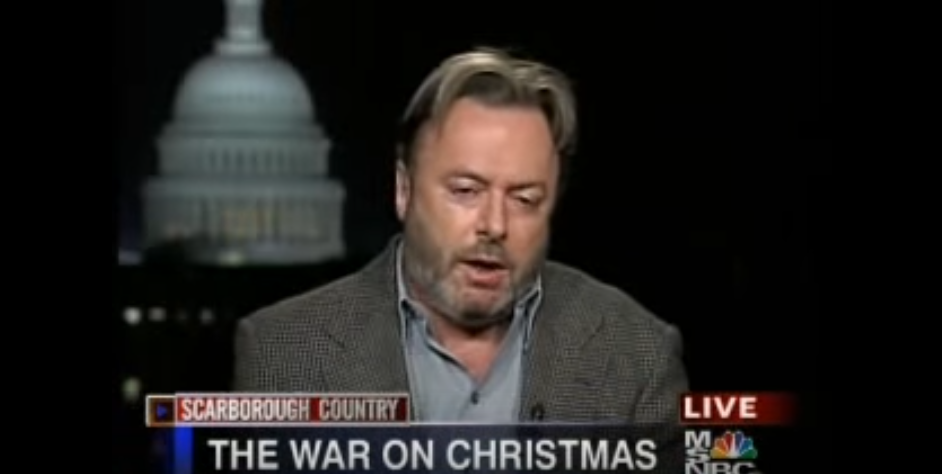
How I miss Christopher Hitchens.
Introductory excerpts from Hitchens' timeless essay are reprinted below, so be sure to follow the link to read the whole, glorious piece, first noted here at NAC in 2008. I reread this every year on or before Christmas Eve. In 2013, there was added gravity, which also deserves another look.
In 2013, as Christmas approached, I'd just finished reading Ray Mouton's novel, In God's House. In 1984, Ray was the lawyer chosen by the state of Louisiana's Catholic Church hierarchy to defend the first priest ever to be charged in secular court with child molestation. Looking back on the perspective of the present day, we obviously know what became of all this, and that Ray's appointment with destiny was the first tiny peek inside a truly massive scandal. I wasn't expecting to be moved to such an extent by Ray's book, but I was -- and remain.
Carrying these thoughts into my annual date with Hitchens, I find the atheist's cynicism to be vastly enhanced.
… My own wish is more ambitious: to write an anti-Christmas column that becomes fiercer every year while remaining, in essence, the same. The core objection, which I restate every December at about this time, is that for almost a whole month, the United States—a country constitutionally based on a separation between church and state—turns itself into the cultural and commercial equivalent of a one-party state.
As in such dismal banana republics, the dreary, sinister thing is that the official propaganda is inescapable. You go to a train station or an airport, and the image and the music of the Dear Leader are everywhere. You go to a more private place, such as a doctor's office or a store or a restaurant, and the identical tinny, maddening, repetitive ululations are to be heard. So, unless you are fortunate, are the same cheap and mass-produced images and pictures, from snowmen to cribs to reindeer. It becomes more than usually odious to switch on the radio and the television, because certain officially determined "themes" have been programmed into the system. Most objectionable of all, the fanatics force your children to observe the Dear Leader's birthday, and so (this being the especial hallmark of the totalitarian state) you cannot bar your own private door to the hectoring, incessant noise, but must have it literally brought home to you by your offspring. Time that is supposed to be devoted to education is devoted instead to the celebration of mythical events ...
NA Confidential is sliding into oblivion, and so to close out the abysmal year of 2020, I'll be making a daily post from the archives.
---
Books: "Giving the finger" -- and no, not at a Board of Public Works meeting.
May 17, 2016
Kudos to the Indiana University Press, because this long overdue translation of a study of gesture is far better cause for celebration than a mere IU basketball game. It reminds me of being in Italy and seeing people communicate with hands in addition to words.
Incidentally, the author's mention of Luigi Barzini's classic book The Italians reminds me of the "mut read" stature it once enjoyed. During the 1970s and 1980s, travelers to Italy always were advised to read The Italians before leaving home.
I've a strong suspicion that the wisdom of this recommendation still holds true, even 50 years after publication, and so I'll reread Barzini before we visit Sicily this autumn.
As for the gestures, maybe only one or two, just in case ...
GESTURE IN NAPLES AND GESTURE IN CLASSICAL ANTIQUITY, by Andrea de Jori; translated by Adam Kendon ... Indiana University Press; 632 pages; $49.95 and £34
A MAN and a woman are talking on a bus in Naples. All of a sudden, the man raises his hand, draws together his fingertips, lifts them to his lips and appears either to spit on them or to give them a kiss before pointing them at the woman. How to know whether his intentions are noble or base, romantic or murderous—spitting on one's fingertips being the second most deadly insult in Naples after spitting directly in your face?
The answer may well be found in Andrea de Jorio's extraordinary volume, “Gesture in Naples and Gesture in Classical Antiquity”, now finally translated into English almost 170 years after it was first published ...
... In modern times, Luigi Barzini was the writer who did most to put out the word on de Jorio and his classic. In “The Italians” (1964), Barzini described “Gesture in Naples” as a gem, though one so difficult to obtain that he had to resort to purloining a copy from an unsuspecting English gentleman. Thanks to a fine translation by Adam Kendon, an anthropologist who has studied aboriginal sign language—and to the imagination of Indiana University Press—thefts of this kind will no longer be needed.
NA Confidential's mask-free policy on reader comments.
NA Confidential believes in a higher bar than is customary in the blogosphere, and follows a disclosure policy with respect to reader comments.
First, you must be registered with blogger.com according to the procedures specified. This is required not as a means of directing traffic to blogger.com, but to reduce the lamentable instances of flaming and personal attacks on the part of the anonymous.
Second, although pen names are perfectly acceptable, senior editor Roger A. Baylor must be informed of your identity, and according to your preference, it will be kept confidential.
To reiterate, I insist upon this solely to lessen the frequency of malicious anonymity, which unfortunately plagues certain other blogs hereabouts.
You may e-mail Roger at the address given within his profile and explain who you are. Failure to comply means that your comments probably will be deleted -- although the final decision remains ours.
Thanks for reading, and please consider becoming a part of the community here, one that is respectful of the prerequisites of civilized discourse, and that seeks to engage visitors in substantive dialogue.